
When Nina’s arthritis flared, the commute vanished – but the pain did not. At home, the kitchen table became her desk, her laptop a daily reminder that productivity had a cost. A simple ergonomic chair and voice recognition software transformed her day from endurance to engagement.
Her story is not unusual. It is a testament to why reasonable adjustments for remote workers matter: because dignity, autonomy, and performance rise together when employers act with care and compliance.
The Changing Nature of the “Workplace”
The expansion of hybrid and fully remote work has reshaped how employment law interacts with the concept of a workplace. Prior to 2020, remote working arrangements were often treated as exceptional. Today, millions of UK workers perform their roles partially or entirely from home.
According to recent Office for National Statistics data, around 40% of workers in Great Britain now work remotely for at least part of their week, with roughly 28% following a hybrid pattern and around 14% working entirely from home, a structural shift that has continued to influence workplace design and employer obligations.
This transformation has significant legal implications. The duties imposed by the Equality Act 2010 did not change when work moved beyond the traditional office, but the contexts in which those duties operate have broadened considerably.
For employers, this means the legal responsibility to identify and remove disadvantage must extend beyond the corporate premises and into the environments where work now actually takes place.
In practice, that may include kitchens converted into workspaces, spare bedrooms used as offices, or flexible shared living arrangements where space, equipment and accessibility vary widely.
Remote working therefore does not diminish the duty to make reasonable adjustments. If anything, it demands greater awareness and proactive engagement from employers seeking to meet their obligations.
The legal position on the duty to make reasonable adjustments

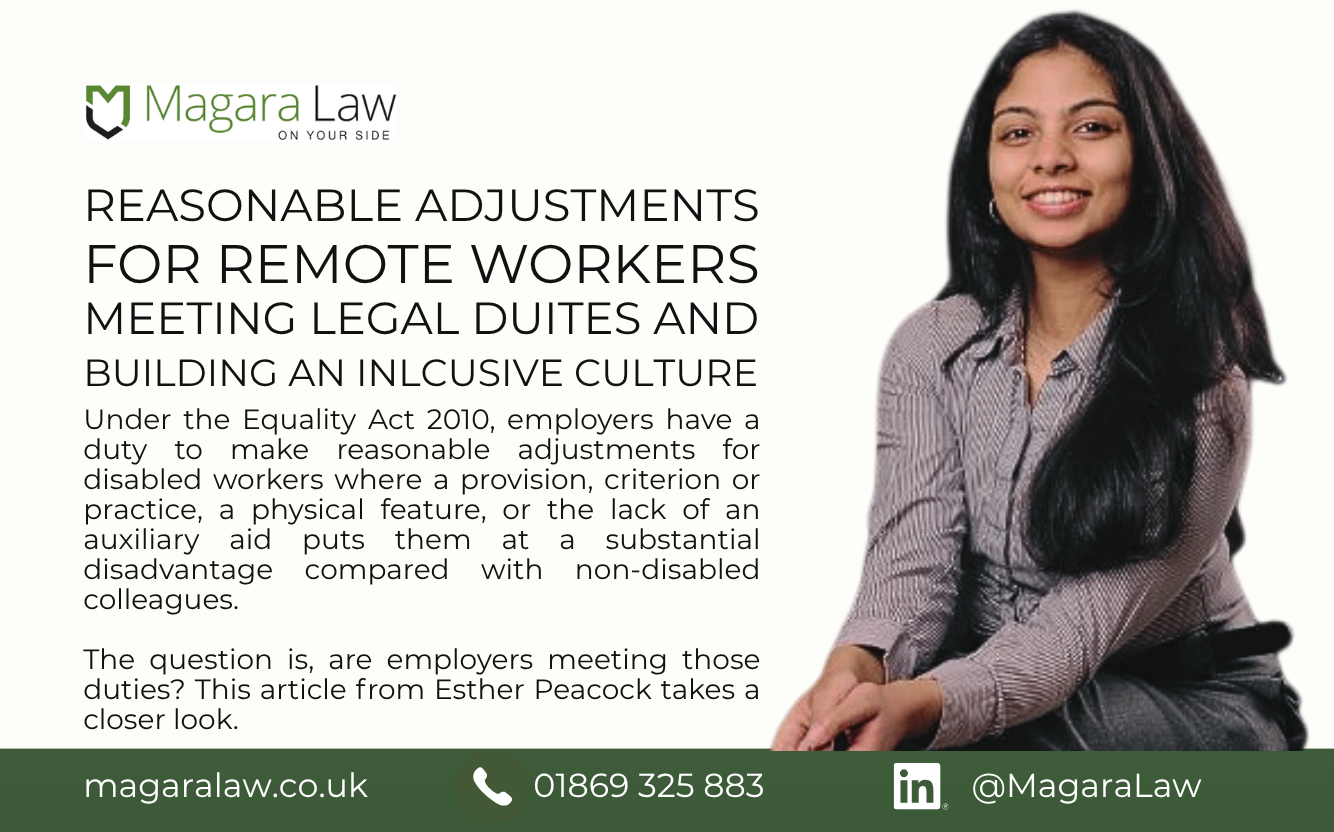
Under the Equality Act 2010, employers have a duty to make reasonable adjustments for disabled workers where a provision, criterion or practice, a physical feature, or the lack of an auxiliary aid puts them at a substantial disadvantage compared with non-disabled colleagues.
That duty applies just as much to home and hybrid environments as to traditional offices. The question is not whether the workplace has four walls, but whether the employee can access, participate and perform without avoidable barriers.
The starting point is individual need. No two employees, conditions or home set-ups are identical. Employers should engage promptly with the worker to understand what is difficult, what has already been tried, and what would help.
Occupational health input can be valuable, but listening is indispensable. The legal test is “reasonableness,” assessed against effectiveness, practicability, cost, and available resources, not a rigid checklist. A focused dialogue, recorded in writing, shows respect and creates a defensible audit trail.
What the courts have said about “reasonableness”
Employment tribunals have repeatedly emphasised that the duty to make reasonable adjustments is anticipatory and proactive, not merely reactive.
In Archibald v Fife Council [2004] UKHL 32, the House of Lords confirmed that employers may be required to depart from normal procedures – including recruitment or redeployment practices – where doing so would remove disadvantage for a disabled worker.
Similarly, in Environment Agency v Rowan [2008] IRLR 20, the Employment Appeal Tribunal clarified that tribunals must assess three key elements when evaluating a reasonable adjustment claim:
- The provision, criterion or practice applied by the employer.
- The disadvantage experienced by the disabled employee.
- The adjustment that could reasonably remove that disadvantage.
These principles remain central to modern reasonable adjustment cases, including those arising in remote working environments.
The law does not demand perfection, but it does expect careful consideration, documented decision-making and genuine engagement with the employee’s circumstances.
Flexible working arrangements often make adjustments effective. Adjusted hours, split shifts, regular breaks, phased returns and predictable meeting times can remove substantial disadvantages without reducing output.
Where time zones or caring responsibilities intersect with health needs, clarity about core hours and performance expectations protects both fairness and delivery. Flexibility is not laxity; it is the disciplined design of work around capability.
The overlooked risks of home workstations

One emerging challenge in remote work arrangements is the assumption that home environments are inherently suitable for work. In practice, this assumption can create hidden barriers for disabled employees.
Research by the Chartered Institute of Personnel and Development (CIPD) has found that many remote workers operate from workspaces that were never ergonomically designed, increasing the risk of musculoskeletal strain, fatigue and reduced productivity.
For employees with existing health conditions – such as arthritis, chronic pain, visual impairments or neurological conditions – these barriers may become substantial disadvantages within the meaning of the Equality Act.
Employers who fail to consider these risks may unintentionally create a provision, criterion or practice that disadvantages disabled workers.
For example, requiring full-time home working without assessing workstation suitability could expose the organisation to legal challenge if the arrangement exacerbates a disability.
That’s why employers should assess the home workstation, remotely if necessary, and fund or supply adjustments promptly.
Suitable equipment is frequently decisive for remote workers. Ergonomic chairs, desks, footrests and monitor risers, larger screens, alternative keyboards, trackballs, noise-cancelling headsets, screen readers and voice-to-text software can transform access and reduce absence.
Ownership, maintenance, insurance, and data security should be agreed in writing, with a straightforward process for repair and replacement. Small, timely investments usually prevent larger costs in lost productivity and ill health.
Furthermore, open communication sustains adjustments over time. Regular check-ins allow employers to test whether measures work and to adapt when needs change. Managers should be trained to ask open questions, avoid assumptions about health, and maintain confidentiality.
Clear signposting to policies, reasonable adjustment passports and points of contact reduces the burden on employees to “re-explain” their needs each time responsibilities or managers change.
Consistency is essential. Policies must apply equally across teams and locations, with decisions recorded against transparent criteria. Where adjustments are declined, reasons should be explained and alternatives offered where possible.
Consistency does not mean uniformity; it means applying the same principles to different facts, and documenting the rationale. This approach mitigates legal risk, supports fairness and reinforces trust.
The strategic value of adjustment culture

Forward-thinking organisations increasingly recognise that reasonable adjustments are not only a compliance obligation but also a strategic leadership issue.
The Business Disability Forum has reported that over 80% of disabilities develop during working life rather than being present from the outset of employment. This means that any workforce, regardless of size or sector, will inevitably encounter situations where adjustments are needed.
Employers who respond constructively often retain experienced staff, protect institutional knowledge and demonstrate credibility in their culture and leadership. By contrast, organisations that resist adjustments may face the combined costs of litigation, recruitment, reputational harm and lost expertise.
Inclusive workplace practices also resonate strongly with younger generations entering the workforce, many of whom expect employers to demonstrate visible commitments to accessibility and wellbeing.
The business case is compelling. Inclusive remote cultures widen the talent pool, reduce turnover, enhance engagement, and improve performance. Adjustments often benefit entire teams by promoting better meeting etiquette, clearer documentation, and more predictable workflows.
In a competitive market, the employers who remove barriers win the contribution and loyalty of people who might otherwise be sidelined.
Legal risks for employers for lack of proper implementation of reasonable adjustments
If an employer fails to implement reasonable adjustments correctly, within a reasonable timeframe, or at all, an employee may bring claims in the Employment Tribunal under the Equality Act 2010. Depending on the facts, potential claims can include:
- Failure to make reasonable adjustments, where a provision, criterion or practice, or a physical feature, places the disabled employee at a substantial disadvantage and the employer does not take reasonable steps to avoid that disadvantage.
- Discrimination arising from disability, where the employee is treated unfavourably because of something arising in consequence of their disability and the treatment is not a proportionate means of achieving a legitimate aim.
- Indirect disability discrimination, where a provision, criterion or practice is applied to all but puts disabled employees at a particular disadvantage compared with others and is not a proportionate means of achieving a legitimate aim.
- Harassment related to disability, where unwanted conduct related to disability has the purpose or effect of violating the employee’s dignity or creating an intimidating, hostile, degrading, humiliating or offensive environment.
- Victimisation, where the employee is subjected to a detriment because they have done, or are suspected of doing, a protected act, such as raising concerns about reasonable adjustments or bringing discrimination proceedings.
Tribunal trends and financial exposure
Compensation for successful disability discrimination claims in the Employment Tribunal is uncapped. Awards may include financial losses, injury to feelings, aggravated damages and interest.
The Vento bands, which guide tribunals in assessing injury to feelings awards, currently range from approximately £1,200 to over £58,000 depending on severity, with the most serious cases exceeding that upper band in exceptional circumstances.
Recent tribunal statistics published by the Ministry of Justice show that disability discrimination claims consistently represent one of the most common types of discrimination claim brought before Employment Tribunals.
For employers, the legal exposure therefore extends beyond compliance failure. It includes the potential financial impact, reputational consequences and management time required to defend proceedings.
The Magara Law perspective
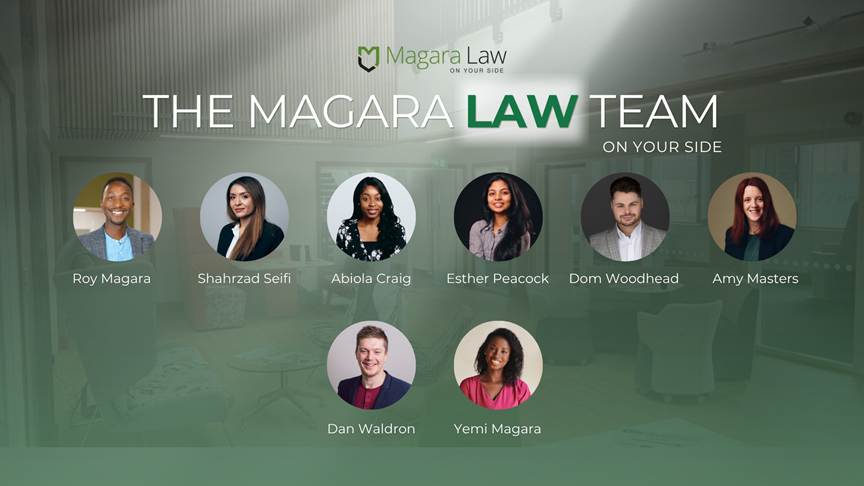
As a trainee solicitor at Magara Law I, along with my colleagues, regularly see that disputes around reasonable adjustments rarely arise because employers deliberately intend to act unfairly.
More often, the issue stems from uncertainty, delayed decision-making, or a lack of structured processes for addressing employee health needs in modern working environments.
Remote and hybrid working arrangements have made this challenge more complex. Employers must balance operational demands, fairness across teams and the individual needs of workers whose home environments may vary significantly.
From a legal perspective, the most effective organisations approach reasonable adjustments through three principles:
Early dialogue. Employers who engage with employees at the earliest stage of difficulty are far more likely to identify workable solutions before problems escalate into grievances or tribunal claims.
Structured decision-making. Clear documentation of conversations, assessments and decisions protects both employer and employee by demonstrating that the issue has been considered carefully and lawfully.
Consistency with compassion. Applying policies consistently while remaining sensitive to individual circumstances builds trust and reduces the likelihood of conflict.
For employees, understanding their rights is equally important. Workers should feel able to raise concerns about barriers to their work without fear that doing so will jeopardise their position.
When reasonable adjustments are approached constructively, they protect dignity, improve productivity and support healthier workplaces. When they are overlooked or mishandled, they can lead to disputes that are costly both financially and culturally.
A workplace standard, not an exception
Reasonable adjustments for remote workers are not special favours. They are a statutory requirement and a hallmark of good leadership.
By understanding individual needs, embracing flexible work design, providing the right equipment, communicating openly, and applying policies consistently, employers meet their Equality Act duties and unlock the full value of their people – at home as much as in the office.
If you are an employer seeking guidance on your duties under the Equality Act 2010, or an employee who believes reasonable adjustments have been overlooked or refused, the employment law team at Magara Law can help.
Our solicitors advise both employers and employees on reasonable adjustment obligations, workplace policies and disability discrimination claims.
If you would like tailored advice on your situation, get in touch with Magara Law today. Call 01869 325 883 or email hello@magaralaw.co.uk to arrange your consultation.